Tricky · 2026
Release Intelligence
Deterministic classification replaced a black-box LLM step, cutting the unexplainable custom bucket from 40–60% to under 5%.
The model handles voice and format only. Python owns classification and grouping, verbatim narrative seeds constrain generation, and a proportional review gate routes the PM to the 2–3 items that matter.
Role
AI systems designer · pipeline architect
Outcome
Five consistent outputs per cycle, a deterministic audit trail, and a workflow handed off for non-engineering ownership.
The operating story
What the system held,
and what it left human.
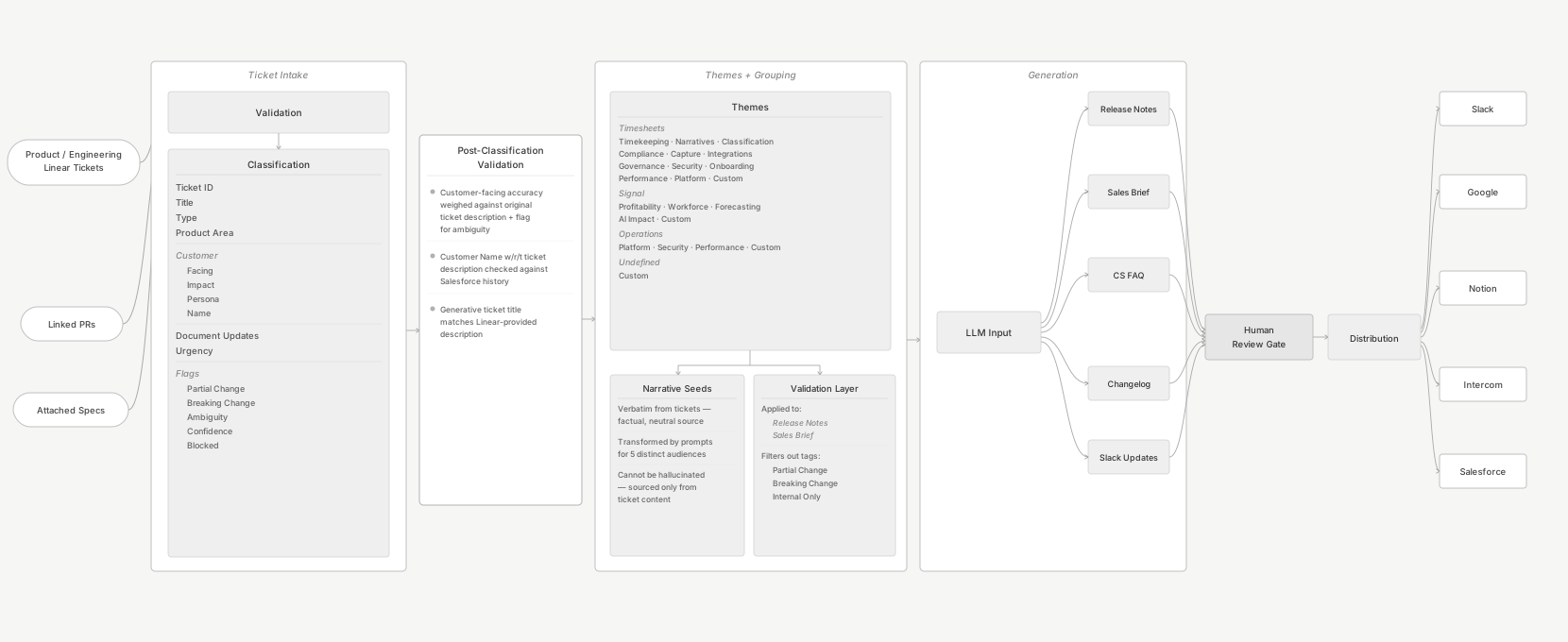
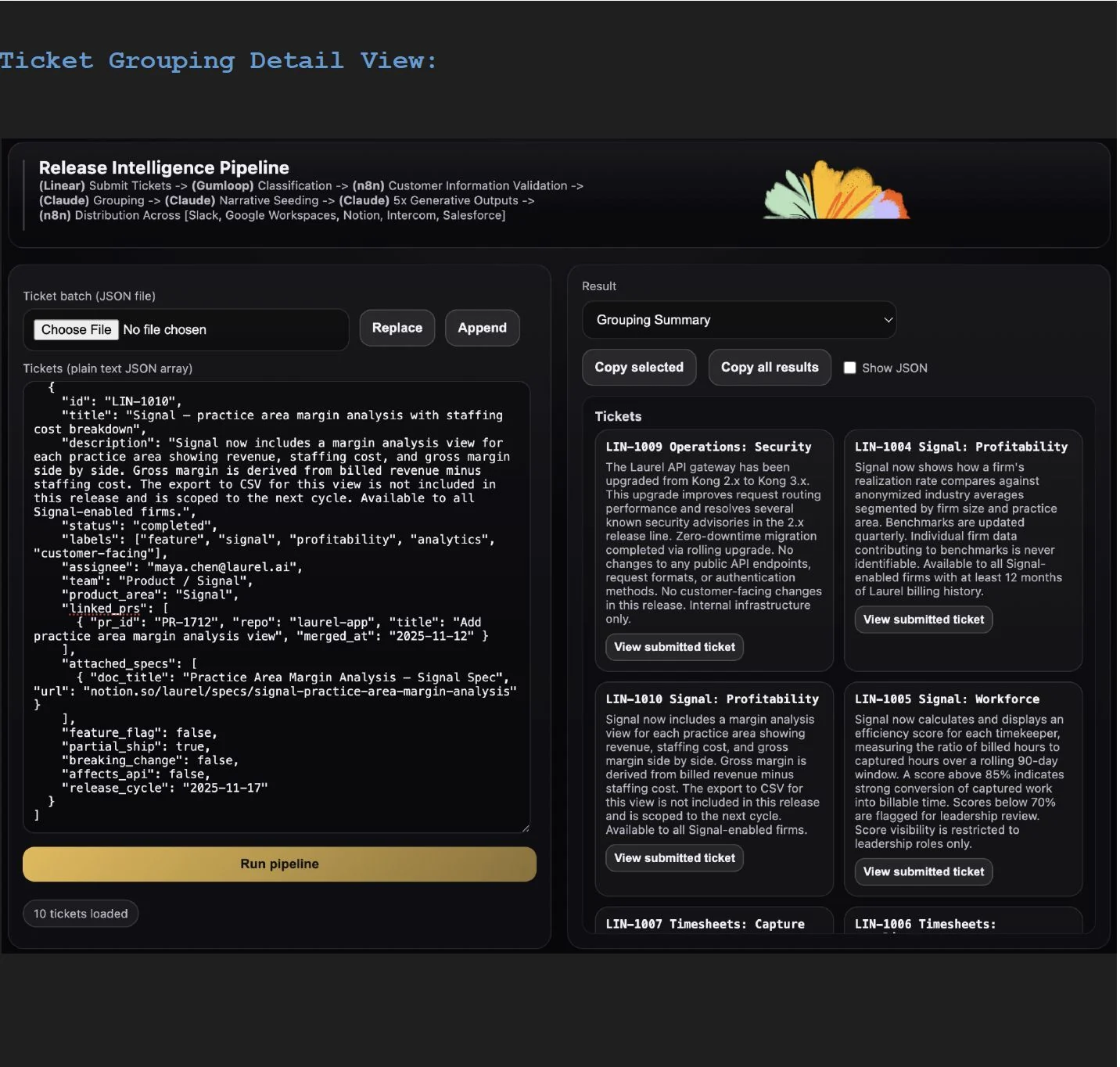
One release cycle required the same Linear tickets to be rewritten for five audiences: customer release notes, internal changelog, sales brief, support FAQ, and Slack. A first all-LLM approach failed in the useful way—tickets classified differently across runs, 40–60% fell into an unexplainable custom bucket, and nobody could see why. The fix was architectural, not another prompt. Classification and grouping moved into deterministic Python; the model became responsible only for voice and format. Six stages and a sixteen-field schema feed five audience-specific prompt contracts. Verbatim narrative seeds prevent unsupported feature claims. Three validation passes each target a failure the model had actually made. Across 12+ batches and 100+ tickets, the custom bucket fell below 5% and PM work dropped from 3–5 hours to 20–40 minutes. A review gate concentrates attention on the 2–3 high-risk items instead of pretending the system no longer needs an owner.
By the numbers
- 40–60% → <5% custom bucket
- 3–5 hr → 20–40 min per cycle
- 12+ batches / 100+ tickets
Artifacts that carry the case
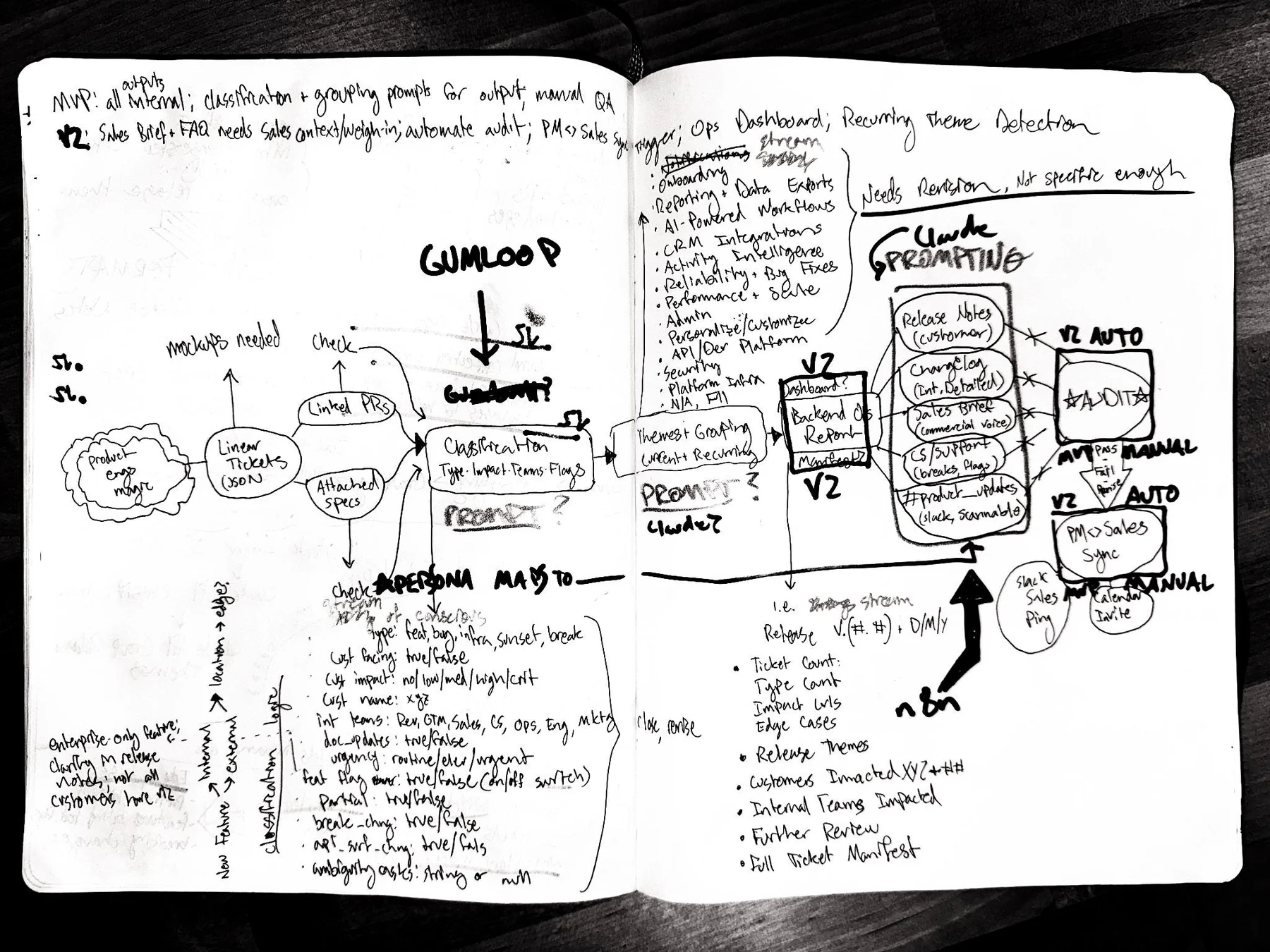
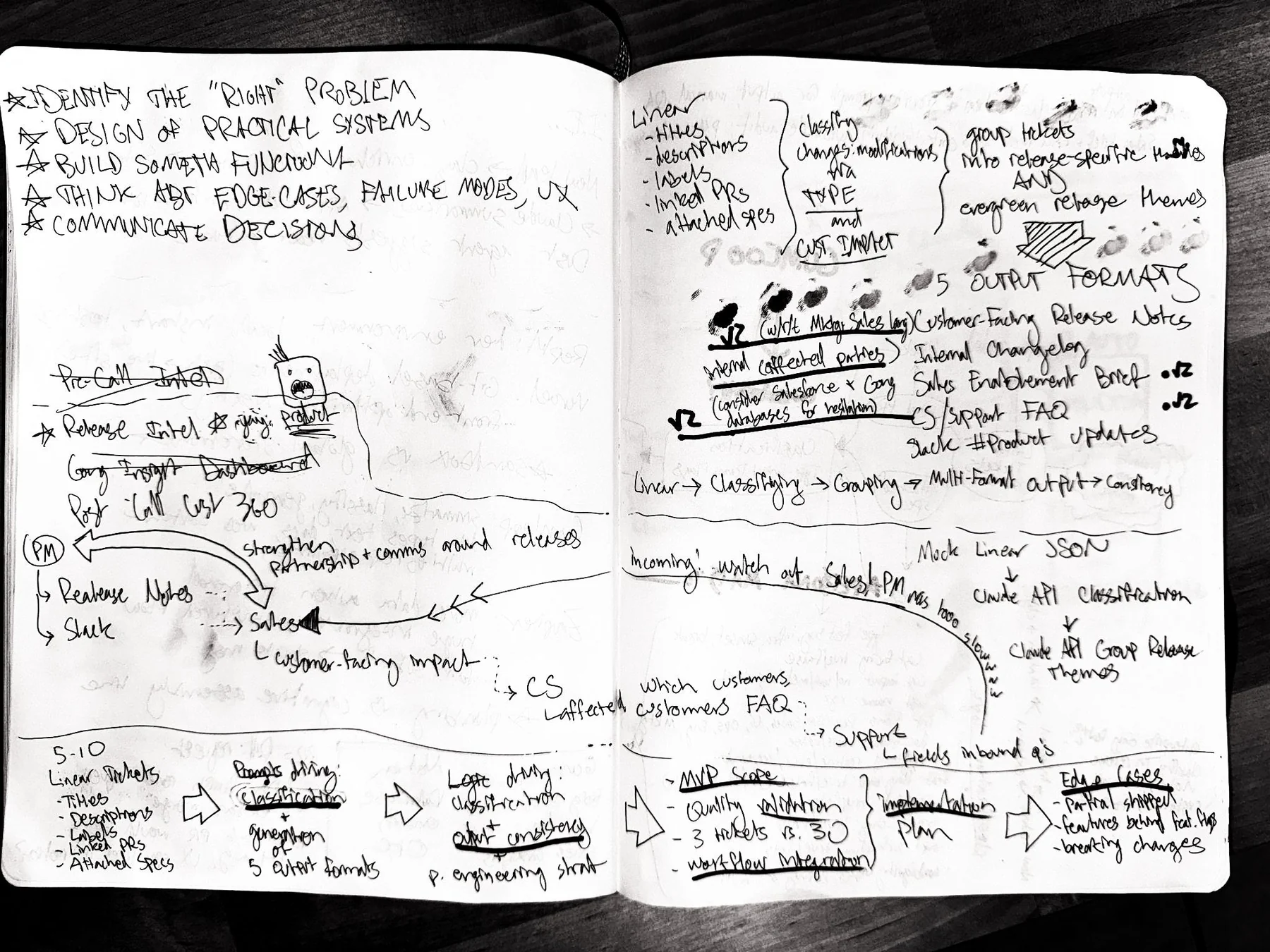
- Pencil architecture → functional system
- Six-stage pipeline diagram
- Batch-by-batch error table
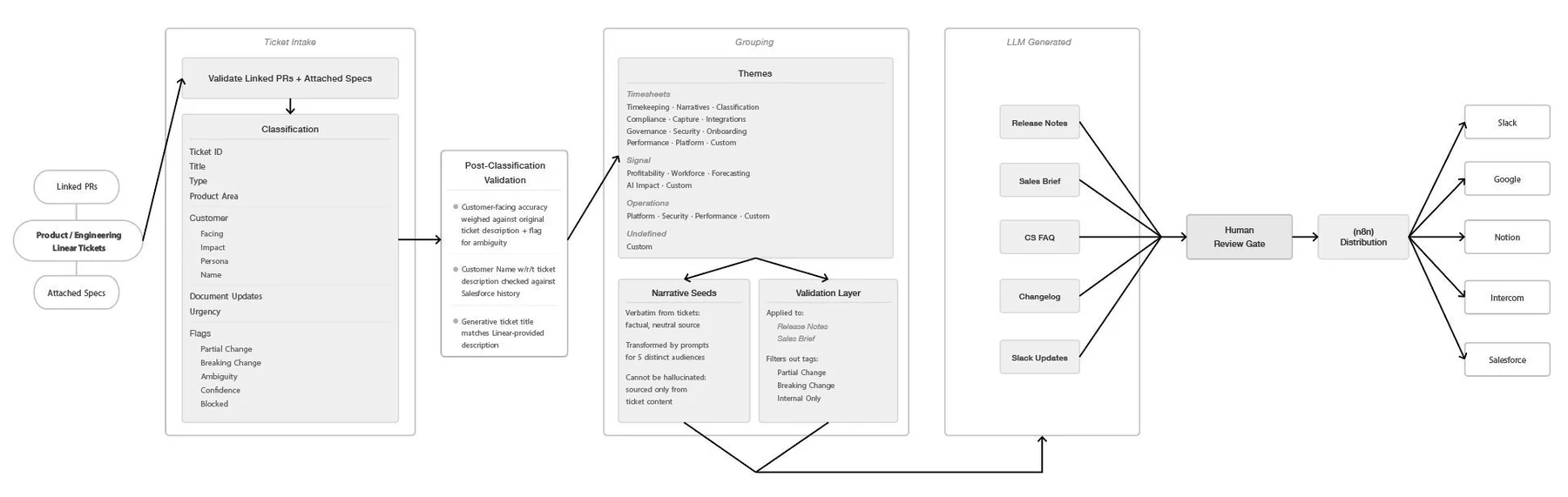
Move facts out of the model
Deterministic Python owns classification and grouping, so identical tickets produce identical, auditable results.
Constrain generation
Each audience has its own contract, but every claim must originate in a verbatim narrative seed from the source ticket.
Review proportionally
Validation routes PM attention to 2–3 high-risk items instead of demanding blanket review or pretending review is unnecessary.